Pages

Showing posts with label Gary Brunner. Show all posts

Monday, January 20, 2020

HEC-RAS Pub & Grub - HEC-RAS 5.1 and Beyond

Don't miss this great opportunity to listen to and interact with the HEC-RAS Developers in a fun and casual atmosphere!  Gary Brunner, Cameron Ackerman, and Mark Jensen will all be speaking at this Pub & Grub on Feb 20, 2020 from 5:30 pm to 8:30 pm in Portland Oregon.  They'll be covering all of the latest features being added to the upcoming Version 5.1 and beyond!  Show up, get some food, grab a pint and enjoy!

This is a free event, but we need you to sign up on our Eventbrite page so we can get a good head count.  Space is limited.  Hope to see you there!


Thanks to our Platinum sponsors Wolf Water Resources, Mead & Hunt, and Galileo and our Gold sponsors David Evans & Associates, OTAK, Geosyntec, and WEST Consultants.  Your generous contributions have made it possible to bring our guest speakers and provide the food.  A special thanks to the Craft Brew Alliance and pH Experiment for providing the awesome venue.  


Friday, December 13, 2019

HEC-RAS Pub & Grub 2! HEC is coming to town!

HEC-RAS...Portland...Food...Beer.  They seem to just go perfectly together.  That is why we're hosting...

HEC-RAS Pub & Grub 2

You will want to save this date!  On Feb 20, 2020

HEC's very own Gary Brunner, Cameron Ackerman, and Mark Jensen

will be joining me in Portland Oregon to speak at the next offering of the HEC-RAS Pub & Grub. The HEC-RAS developers themselves!  They're going to present all of the latest features coming out in the soon-to-be-released HEC-RAS Version 5.1 and plans for future versions.  

Bring your HEC-RAS questions and come join us talking HEC-RAS at this awesome venue over some food and drink.  

And as a bonus, the Craft Brew Alliance's pH Experiment will be on hand to share some of the latest innovative brews they have in the works.    And this HEC-RAS Pub & Grub will have a very special HEC-RAS-related musical feature you won't want to miss.  Yes, that's a teaser. 😊  

For now, just mark your calendar and keep an eye out for more details to come.  If you want more information or are interested in helping to sponsor the HEC-RAS Pub & Grub, please email me Chris.Goodell@KleinschmidtGroup.com or GinaRenee Autry at GinaRenee.Autrey@KleinschmidtGroup.com


Wednesday, January 16, 2019

Bug Report for HEC-RAS 5.0.6

RAS Users:  Please give this "Known Issues" report a read if you're using Version 5.0.6.  If you've been doing a lot of 2D modeling, it's likely you have been affected by some of these.


This link includes a document of "Known Issues" found in version 5.0.6 of HEC-RAS to date.  The
document outlines all of the Issues (bugs) we have found so far.


Please look closely at this document, as there as a few issues that are potential computational problems.  Specifically issues 1, 2, 5, and 7.  Please review these issues closely.  If you have any of these situations use the suggested work around, or solution to get past the issue.  Everyone should look at issue 1 and 2, as they are possible in many models.

Sorry for any inconvenience this may cause you.  Keep letting us know if you find other problems with the software.


Gary W. Brunner, P.E., D. WRE, M. ASCE
Senior Technical Hydraulic Engineer
Hydrologic Engineering Center, USACE

Friday, January 11, 2019

Preview of the new Finite-Volume Approach for 1D Reaches

One of the most anticipated new features soon to come in the next major version of HEC-RAS (Version 5.1) is the option of running unsteady 1D reaches with a finite volume solution scheme.  This will be a fantastic addition to HEC-RAS.  Gary Brunner recently gave me a brief overview of the new finite volume feature we can expect.  But before you ask, there is no set release date for Version 5.1 yet.  But I'm hoping we'll see it within the next year or two.


1D Finite Volume Solution Algorithm

By Gary W. Brunner, P.E., D.WRE
Senior Technical Hydraulic Engineer
Hydrologic Engineering Center

A brand new solution algorithm has been developed for 1D modeling.  A Finite-Volume solution approach, similar to what was added for 2D modeling will be available for 1D modeling in HEC-RAS version 5.1.

The current 1D Finite Difference solution scheme has the following deficiencies:
  1. Cannot handle starting or going dry in a cross section
  2. Low flow model stability issues with irregular cross section data
  3. Extremely rapidly rising hydrographs can be difficult to get stable
  4. Mixed flow regime (i.e. flow transitions) approach is approximate
  5. Stream junctions do not transfer momentum

The new 1D Finite Volume approach has the following positive attributes:
  1. Can start with cross sections completely dry, or they can go dry during a simulation (wetting/drying)
  2. Very stable for low flow modeling
  3. Can handle extremely rapidly rising hydrographs without going unstable
  4. Handles subcritical to supercritical flow, and hydraulic jumps better.
  5. Junction analysis is performed as a single 2D cell when connecting 1D reaches (continuity and momentum is conserved through the junction).


Additionally, the new 1D Finite Volume approached is solved in the same matrix as the 2D equations.  Solving in the same matrix allows for faster 1D/2D model solutions and more accurate flow transfers between 1D and 2D elements.  The equations are solved together and all hydraulic connections are updated together on an iteration by iteration approach, rather than separately, as in previous versions of HEC-RAS.

Monday, December 14, 2015

HEC-RAS 5.0 versus TUFLOW versus MIKE21 – HEC’s official response

In case you haven’t seen it, there has been a very popular LinkedIn discussion on the Hydraulic/Hydrologic Modeler’s Forum debating the advantages, disadvantages, and merits of HEC-RAS 5.0, TUFLOW, and DHI’s MIKE21.  There was a lot of great information (and some misinformation) and insight provided in that thread.  It is well worth the read.  Some of the misinformation was directed at the beta version of HEC-RAS Version 5.0.  Enough that HEC decided to publish a response to clear up any confusion.  
At play is a result of HEC-RAS’s 2D solution scheme using the full shallow water equation where for highly dynamic events where flows severely contract, using too small of a time step could lead to a divergence from the true solution, rather than a convergence.  This is not an issue when a computation interval is selected within the guidance presented by HEC in their user’s manual.  While HEC disagrees that this is a necessarily a “problem” with its software, as some on the discussion claim,  HEC has elected to make this a non-issue by “improving the portion of the full shallow water equation formulation, such that user’s will be able to use very small time steps without the results changing significantly.”   I’ve included HEC’s response, written by Gary W. Brunner, to the LinkedIn discussion below, but I highly recommend you read the LinkedIn discussion first by clicking here
I’m posting this not just to allow HEC to reach a larger audience with their rebuttal, but also because there is a LOT of great information in this document about how HEC-RAS 2D works and how we, as HEC-RAS 2D modelers should use it.  Please enjoy!  A downloadable pdf is available here.
The following text is copyrighted by the Hydrologic Engineering Center and Gary W. Brunner:


Wednesday, May 6, 2015

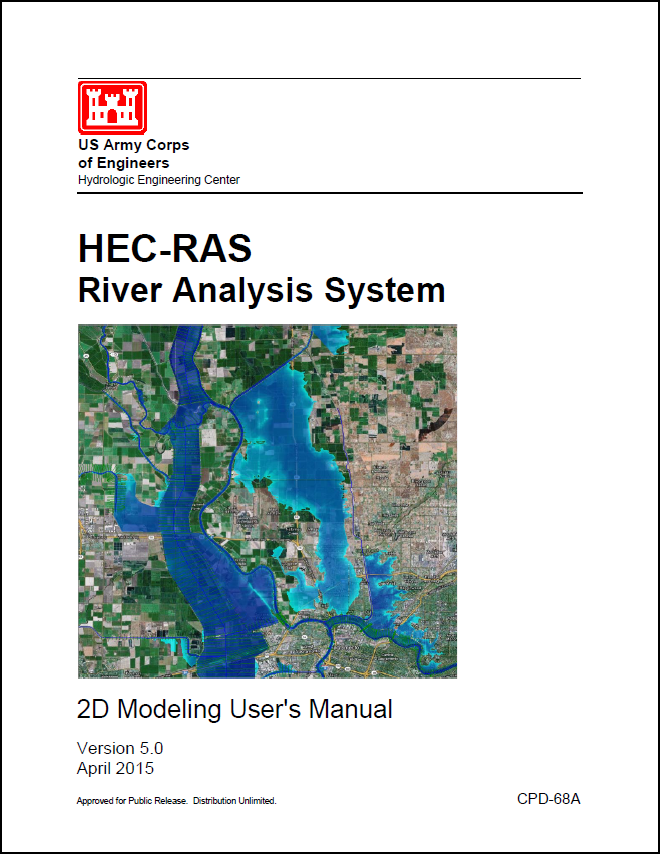
New HEC-RAS 2D Modeling User’s Manual

In advance of the final release of Version 5.0 (hoping for this summer), HEC has released its 2D Modeling User’s Manual, written by Gary Brunner, the HEC-RAS Team Leader.  This manual contains updates to all of the information that was put out in the previous guidance document, “Combined 1D and 2D Modeling using HEC-RAS” as well as more discussion on developing your terrain, creating the 2D mesh, combining with 1D elements, and avoiding errors and instabilities.

If you plan to run a 2D or combined 1D/2D model in HEC-RAS, please read this manual.  Mr. Brunner has done a fantastic job putting together this very well-written document with easy-to-understand instructions and guidance for setting up and running a 2D or combined 1D/2D model in HEC-RAS. 

You can get a free electronic copy of the HEC-RAS 2D Modeling User’s Manual here, or by clicking on the link on the side bar to the right. 
 
An excerpt from the Introduction:
“HEC has added the ability to perform two-dimensional (2D) hydrodynamic flow routing within the unsteady flow analysis portion of HEC-RAS. Users can now perform one-dimensional (1D) unsteady-flow modeling, two-dimensional (2D) unsteady-flow modeling (full Saint Venant equations or Diffusion Wave equations), as well as combined 1D and 2D unsteady-flow routing. The 2D flow areas in HEC-RAS can be used in number of ways. The following are examples of how the 2D flow areas can be used to support modeling with HEC-RAS:
    Detailed 2D channel modeling
  • Detailed 2D channel modeling
  • Detailed 2D channel and floodplain modeling
  • Combined 1D channels with 2D floodplain areas
  • Combined 1D channels with 2D flow areas behind levees
  • Directly connect 1D reaches into and out of 2D flow areas
  • Directly connect a 2D flow area to 1D Storage Area with a hydraulic structure
  • Multiple 2D flow areas in the same geometry
  • Directly connect multiple 2D flow areas with hydraulic structures
  • Simplified to very detailed Dam Breach analyses
  • Simplified to very detailed Levee Breach analyses
  • Mixed flow regime. The 2D capability (as well as the 1D) can handle supercritical and subcritical flow, as well as the flow transitions from subcritical
    to super critical and super critical to subcritical (hydraulic jumps).

2D flow modeling is accomplished by adding 2D flow area elements into the model in the same manner as adding a storage area. A 2D flow area is added by drawing a 2D flow area polygon; developing the 2D computational mesh; then linking the 2D flow areas to 1D model elements and/or directly connecting boundary conditions to the 2D areas.”

(Hydrologic Engineering Center, “HEC-RAS River Analysis System 2D Modeling User’s Manual Version 5.0”, Davis, CA.  April 2015.)