Pages

Showing posts with label Backwater. Show all posts

Monday, January 22, 2018

Bridge Momentum: Understanding the Weight Component

Written by James Woidt, P.E.  |  Woidt Engineering and Consulting
Copyright © The RAS Solution 2018.  All rights reserved


Take a look at the water surface profile in Figure 1 below. The two profiles are for Class A low flow (subcritical throughout) with identical boundary conditions, flow conditions, and geometry. The only difference is the bridge modeling approach: the blue line is calculated using the energy method; the red line is calculated using the momentum method. For this example, which is a simple rectangular channel, the difference in computed water surface elevation and energy grade line from the downstream cross-section to the upstream cross-section is 0.10 feet and 0.16 feet for the energy method, respectively; those differences increase to 1.64 feet and 1.64 feet, respectively, for the momentum method. Those of you well-versed in the applicability of the various bridge modeling approaches (see page 181 of the HEC-RAS River Analysis System, version 5.0, Hydraulic Reference Manual [Brunner, 2016] for a great discussion on this topic), will answer: “the momentum method accounts for the drag imparted by bridge piers on the flow and should be used when pier losses are significant; that’s why.” But check out Figure 2. There are no piers. The bridge doesn’t even touch the water surface!


Figure 1: Comparison of bridge modeling results between energy and momentum methods

Figure 2: Representative cross-section of modeled bridge

From a hydraulic perspective, the bridge is doing nothing in this model. We could ignore it, stick in two cross-sections, press “run”, use the tried-and-trusted energy equation, and be on our way. However, “momentum” has been as familiar and comfortable a term as “energy” ever since we first smashed two model cars in physics class. We know the one-dimensional form of the conservation of momentum equation backwards-and-forwards, have solved the above problem by hand in our open channel hydraulics class, and know that the momentum equation should give us an answer similar, if not identical, to the energy equation. Even though the title of this post gives away the reason for the difference, I’m going to let the suspense build and provide some background to understand the implementation of the momentum equation in HEC-RAS at bridges for steady discharge.

Monday, May 1, 2017

Back to the Basics: Bank Station Placement - Part 2

Written by Martin J. Teal, P.E., P.H., D.WRE  |  Vice President, WEST Consultants 
Copyright © The RAS Solution 2017.  All rights reserved. 


Expanding upon Chris’ discussion of where to place bank stations, what should you do about high terrain somewhere in the middle of your cross section?  Here is an example:


How should we treat the left overbank?  It’s hard to tell if the high area next the left bank is isolated (i.e., it would be an island if the water surface were to get to elevation 370 or so) or if it is a continuous feature (such as a levee) that would prevent flow from accessing the left overbank until it is overtopped.  Looking at this another way, is the lower ground of the left overbank a continuous flow path or is it an isolated low spot (for example, a mining pit)? Aerial photography can often help determine the situation; here is the overhead view for our example:


The area in question is vegetated (the terrain goes up steeply when it gets to the storage yard on the bottom of the photograph) but it is hard to tell if the high point in the terrain would be constraining flow or if the low area is a potential flow path.  Looking at the cross sections upstream and downstream of the one in question will often provide answers, but does not help in this particular example.  In this case, the best course of action would be to go out to the river and see for yourself, then imagine how the water would behave.  Depending on your conclusion, there are several ways that this can be modeled.

1.  Isolated high spot.  If flow can simply go around the high spot in this particular cross section then we probably don’t need any further adjustments. You may get a “divided flow” warning in the output that signifies that the program detected dry ground with water on either side, but no action is needed to address the warning in this case. Assuming that the computed water surface elevation is high enough, this solution will also allow flow in the left overbank.

2.  Isolated low spot in overbank.  You could model this as per #1 above but in that case you should check flow distribution between the channel and overbanks up and downstream of this cross section for reasonable transitions (see earlier blog post from May 20, 2009).  Or, if you think that the low area should only store but not convey water you could set an ineffective flow limit as shown below.


3.  Continuous high ground.  If the high ground is really a ridge that would prevent the water from accessing the lower ground in the left overbank, it should be modeled as a levee. However, in this case another decision needs to be made depending on what happens after the levee is overtopped. Will the water be conveyed on the land side, or will it just pond?  If the latter you may need to add an ineffective flow limit at or just to the left of the levee.

4.  Something in between.  Regardless of whether the high or low features of the cross section are continuous, water is able to access the left overbank.  Natural streams often have “backswamp” areas behind either human-made or natural levees that flood and store water but do not really convey much flow downstream. If the left overbank in our example is like this, we could model it by using the ineffective flow limit as per #2 above.  However, ineffective flow means zero conveyance.  If we expect some water to move in the overbank, albeit very slowly, you may want to allow a small non-zero conveyance.  A few sharp-eyed readers may have noticed that we are using a Manning’s roughness coefficient of 0.3 in the left overbank. Using this value allows a small amount of conveyance in that overbank without zeroing it out completely.

Thursday, August 15, 2013

Careful with Flow Inconsistency on the Max WS Profile

Written by Chris Goodell | WEST Consultants
Copyright © RASModel.com. 2013.  All rights reserved.

I’m a big proponent of checking flow consistency in your results.  Anyone who has taken a RAS class from me has heard me go on about Standard Table 2 and the benefits of maintaining a consistent distribution of flow not only between sub sections (left overbank, main channel, right overbank) in a cross section, but from cross section to cross section.  Any significant change in flow, or flow distribution should be questioned and explained.  Generally there is a problem with ineffective flow definitions, Manning’s n values, bank station placement, or your model is simply unstable (for an unsteady flow model). 
image
After running an unsteady flow model, and you open up the profile output table (also called summary output table), the first profile that pops up is the Max WS profile.  Now, you have to be careful when checking flow distribution with the Max WS profile.  Although it shows up in the plot and tables along with all of the other profiles, the Max WS profile is not a real profile.  It never happened.  It is actually a compilation of all of the highest water surface elevations that happened during the simulation for each cross section-regardless of time.  A “Greatest Hits” of water surface elevations, if you will.  This is exactly what you would plot when producing a maximum inundation map. 
image
For many models, the Max WS profile will do just fine in identifying flow distribution problems with an important exception – reaches that have significant lateral inflows whose peak flows do not line up temporally with the main channel peak flow.  If that lateral inflow sets up a backwater in the main channel, prior to the arrival of the flood in the main channel, it could actually produce a higher peak water surface elevation than the elevation that corresponds to the peak of the main channel flood. 
Here’s an example from a question I recently got from a former attendee of one of my RAS courses.  Warning, this gets a bit detailed and specific-make sure you’re wide awake before reading on… 
Question:  “I’m currently working on an unsteady model where I have my initial flow hydrograph and then two lateral inflow hydrograph’s further downstream.  My question is that at my first lateral inflow hydrograph location the next couple of cross-sections upstream of the inflow point have greatly reduced peak flows.  For instance, the peak flow of the hydrograph entering the upstream end of the reach is around 646 cfs and at the cross-sections just upstream of the lateral inflow that number is reduced down to around 387 cfs.  There is not a drastic change in cross-section shape or stream slope in the area of the lateral inflow.  Have you run across this type of thing before?  Is this realistic or is something in the model not quite right?  Any thoughts would be greatly appreciated.”
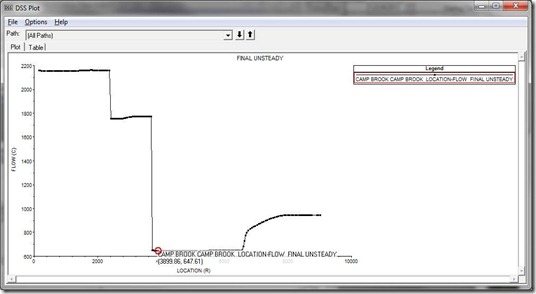
Response:  What looks like an inconsistency, really is not.  In fact your results look great.  When checking flow consistency, be careful doing this with the MaxWS profile in the summary output table.  This is where you saw the drop from 646.61 cfs to 387.53 cfs from RS 3936.90 to RS 3899.86.  The problem with checking flow consistency on the MaxWS profile is that the maximum water surface does not necessarily correspond to the maximum flow, especially if you are in a backwater area like below.  This backwater is set up by the lateral inflow entered just downstream at RS 3726.34 and happens prior to the arrival of the peak flow in the main channel.  A very common occurrence when modeling a flood in large systems with multiple tributaries.  clip_image001 The peak of the lateral inflow at 3726 happens at 1250 hrs on the 13th.  This sets up a backwater that produces the max ws elevation of 976.52 ft for RS 3899.86.  However, the flow at RS 3899.86 at this moment is only 389.13 cfs.  The peak flow in the main channel has not arrived yet.  clip_image002 The peak flow in the main channel at RS 3899.86 happens after the lateral inflow peak by about 1 hour and 10 minutes.  At 1400 hrs, the backwater effect from the lateral inflow is almost completely gone at RS 3899.86 and the peak flow is 647.59 cfs with a corresponding ws elevation of 976.25 ft.  clip_image003 clip_image004 As a result, what you see in the max ws profile is not the max flow at RS 3899.86, but the flow that is happening during the max ws elevation.  You can see all of this by checking around the stage and flow hydrographs. If you see inconsistencies like this for the max ws profile, you can verify your results are still good by scanning through each individual real profile in the summary output table (cumbersome), or go to the dss file and open up the max flow profile like so: clip_image006 This gives you a plot like this: clip_image008 Notice that the max flow at 3899.86 is indeed in the 650-ish range, which is where it should be.  The big changes in max flow are where you have your lateral inflow hydrographs.